
What Montclair Neighbors' Records Can Show
Each Montclair record answers one narrow question about a block. The county map reveals which parcels touch the subject property. The assessor system adds APN, situs, and a mailing line when the field is public. Recorder documents trace title parties over time. Reverse directories and census rolls can recover a historical listing. No single source is a residents directory for the whole street. Merging them quietly manufactures households.
| Source | What It Shows About a Block | Access |
|---|---|---|
| County GIS parcel map | Parcel polygons, adjacency, boundaries, and layers | Public map browse |
| ARC PIMS parcel record | APN, situs, assessment facts, and public mailing fields | Address/APN search |
| Official Records index | Recorded title parties and instrument chronology | Online index; copies separate |
| Voter information | Self-status or approved-purpose data only | Not public block browsing |
| City, Chamber, and library sources | Officials, civic contacts, events, and voluntary directories | Public contact layer |
| Reverse directories and census | Past household snapshots when coverage exists | Repository or database access |
Owner and mailing fields suggest a paper trail, not a person at home. A Chamber listing is a voluntary contact. A council or police page shows a public role. Community groups keep private membership lists. Pick the source that fits the question, and never turn a tax address into a household claim.
Montclair Neighbor GIS Defines Blocks
Parcel polygons, not ZIP codes, define a block properly. Search the subject address and select its parcel on the county map. Save the APN before anything else. Then click the parcels on each side, behind, and across the street. Layers and the identify tool add boundary and district context. Corner lots, rear parcels, and condominiums can quietly change what next door means.
County map applications revise their menus and controls over time. Record the map date, then check each parcel in the assessor system. The map gives adjacency. The assessor gives facts, and the recorder gives instruments. None of them hands you a complete block roster.
- Adjacent parcel
- A mapped parcel that shares a boundary or is identified as nearby; visual closeness is not enough.
- APN
- The parcel number used to carry a map selection into assessor and deed records.
- Block worksheet
- A research note that keeps each APN, source, date, and conclusion separate.
Montclair Voter Records Are Not Block Lists
My Voter Status checks one voter, not a street. It asks identity fields and returns status, party preference, districts, and vote-by-mail details for that person alone. It does not reveal who else is registered at an address. Public browsing of a block is off the table. Elections Code §2194 governs fuller file access. The County Registrar requires a qualifying purpose, a stated geography, an intended use, and signed certification.
Names, residence addresses, birth dates, signatures, and credential numbers stay under release rules. Safe at Home participants can be suppressed entirely. Approved recipients must honor permitted-purpose limits on reuse. No street roll can be assembled from it.
San Bernardino County Registrar of Voters information carries the data-request and contact details.
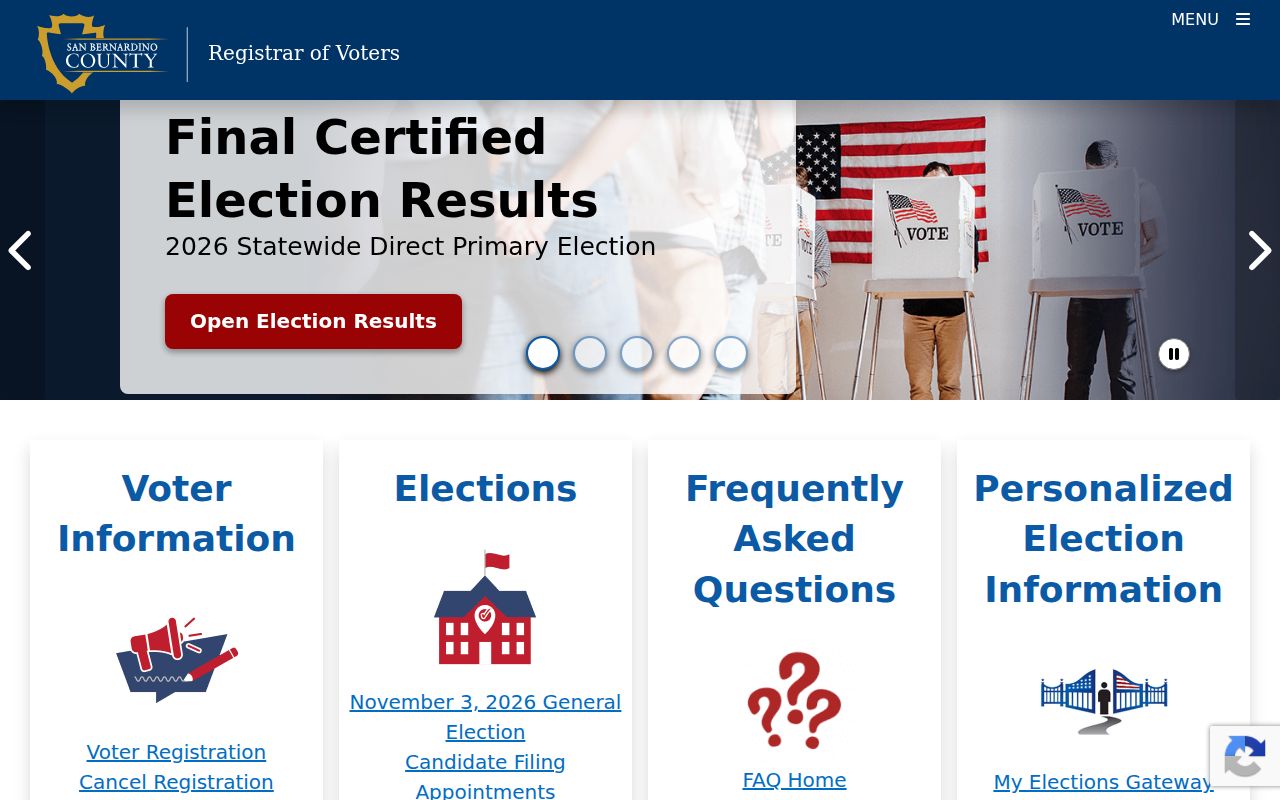
The Registrar's page displays an office and a data-request route. It shows no public list of a Montclair block.
Montclair Neighbor Civic Sources
The city gateway and council pages list meetings, officials, commissions, projects, and municipal contacts. Those records sketch the civic geography around an address. They never amount to a private resident roster. A City Clerk request can pursue an identifiable, nonexempt record, while police and fire units handle incident material under their own redaction rules. The City of Montclair government gateway is the civic starting point.
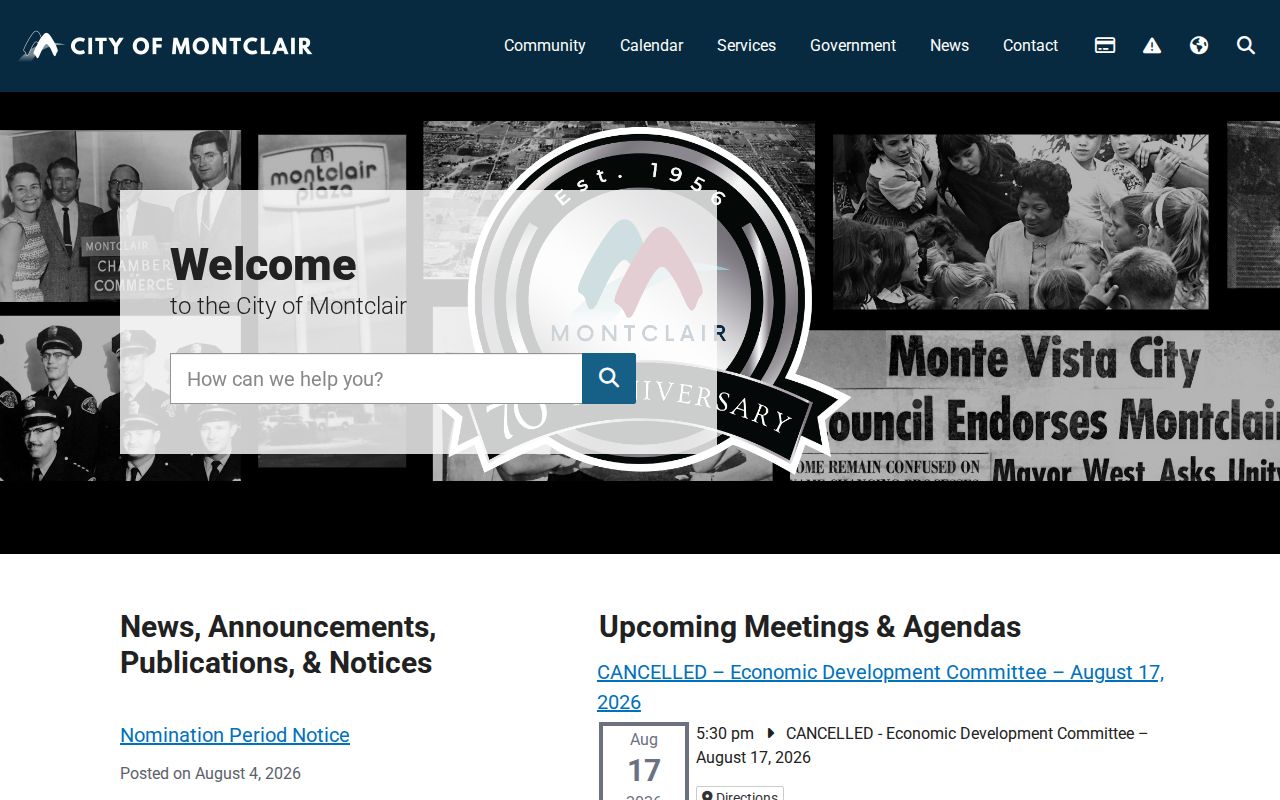
The city gateway offers civic context and official contacts. It is not a neighborhood residents directory. For an incident tied to an address, use the police records route with full event detail. Montclair Police Department information and records is that official route, though exemptions protect victims, juveniles, medical facts, and investigations.
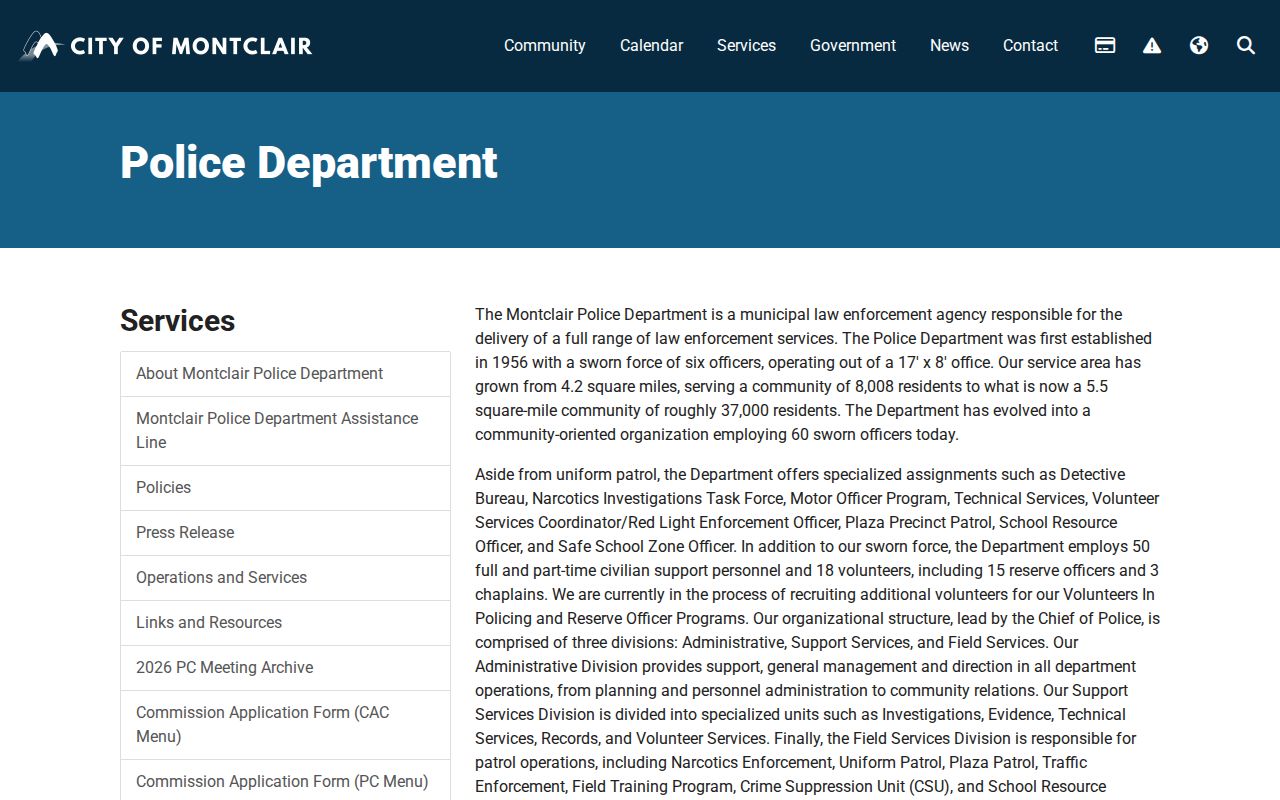
The police page shows procedures, not a household index.
Map a Montclair Block Parcel by Parcel
County GIS makes the adjacent-parcel method practical. Search the address and click its parcel. Zoom out until the side, rear, and opposite polygons appear, then click each one. Corner lots and rear parcels break simple next-door assumptions. Verify each APN in the assessor system, and test jurisdiction with county planning layers.
- Search the address in County ArcGIS or the county Open Data map and select the subject polygon.
- Record its APN, legal description, situs, and any visible assessment categories in a block worksheet.
- Pan and click each touching or nearby parcel, including across the street and behind the subject lot.
- Compare mailing and situs fields without calling either one proof of physical presence.
- For the full named-street chain, switch to the Montclair by-street records workflow.
The sequence is address, then APN, then adjacent polygons, then parcel facts, then deeds or permits. That chain defines a block. ZIP geography is too coarse, and a map alone cannot reveal private household composition.
Montclair Neighbor Community Contacts
Montclair has no comprehensive public directory of neighborhood associations with resident rosters. That absence matters for a block search. Public contacts can still open a civic conversation. Membership cannot be inferred from a parcel, Chamber entry, library card, or city event, so the useful layer is a set of organizations with stated scope.
| Public contact | What it can add | What it cannot prove |
|---|---|---|
| City of Montclair | Meetings, officials, commissions, civic geography | Private household membership |
| Montclair Chamber | Voluntary business, civic, and organization contacts | Residence or full community membership |
| Montclair Branch Library | Catalog, databases, local history, public computers | Obituary retrieval or a private roster |
| County Registrar of Voters | Election administration and lawful data-request route | Open block-level voter browsing |
The library directory lists Montclair Branch, 9955 Fremont Avenue, with its public services.
The library image simply marks a place to start. It shows a research and community resource, not a roster of branch patrons or nearby households. The Montclair Chamber member directory is the better stop, with category, name, and keyword search for voluntary public business and civic contacts.
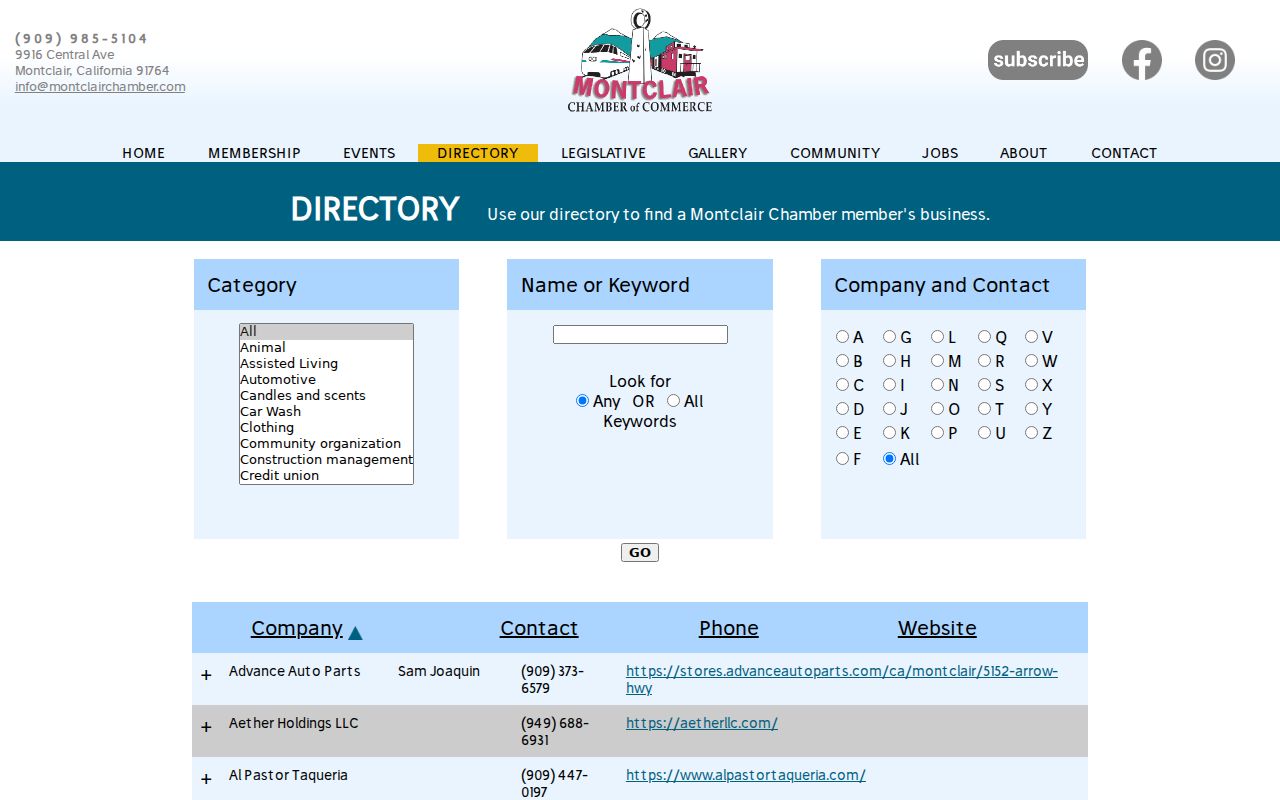
Treat chamber entries as contact leads. They show a business or civic listing, not proof that a named person lives at the listed business or mailing address in Montclair.
Reconstruct Montclair Neighbor Blocks Historically
You can rebuild a past Montclair block by hand. Read consecutive house numbers in a reverse or criss-cross directory. Then compare the listed people against deed parties, the 1950 census, permits, newspapers, and probate. For anything dated before 1958, search under Monte Vista instead. The regional reverse-directory volume's coverage matters more than an exact Montclair-inclusive run, so cite the volume and its coverage rather than claiming a gap-free sequence.
The older records follow a clear time ladder. Start with the current parcel and APN. The Recorder index covers 1958 forward. County books and archives hold earlier San Bernardino material. Los Angeles County keeps records for territory predating the county's 1853 creation. That ladder explains why a block can vanish from an online search yet stay fully present in history.
Montclair Block Evidence Versus Compilations
Official Montclair records are narrow but traceable. A commercial compilation may blend many sources, merge same-name people, keep stale data, or hide where each fact came from. Neither category proves a household. What matters is what you can verify, not which result lists more names.
| Source category | Strength | Limit |
|---|---|---|
| County parcel and deed systems | Named custodian, APN, legal description, instrument trail | Do not show every person at a parcel |
| City and civic records | Official roles, meetings, permits, and identifiable public records | Redactions and no private membership roster |
| Historical directories and census | Time-stamped listed people and household context | Coverage, canvass, and release gaps |
| Commercial people-data compilations | May offer a broad lead across mixed sources | Unknown provenance, stale or merged identities, and no custodian authority |
For a Montclair block, begin with County GIS and PIMS. Then use a defined record request or a historical source. When you find an error, correct it with the office that created the record. Do not treat a compiled listing as final.
Save the source date and the exact field behind each conclusion. An APN supports a parcel match. A deed supports a recorded transaction. A directory supports a dated listing. A city page supports a public civic contact. If two records disagree, keep both observations. Ask the custodian about the discrepancy instead of averaging them into a new household fact.
Privacy Boundaries for a Montclair Neighbor Lookup
A neighbor lookup cannot establish household members, relationships, or present occupancy. It also cannot reveal private utility customers, delivery records, or DMV-derived addresses. A protected voter's location stays shielded too. California Elections Code §2194 limits voter-file disclosure. Safe at Home can replace a qualifying participant's address with a substitute mailing route. Government Code §6208.1 also restricts threatening publication of protected information.
Police and fire records follow their own request, exemption, and redaction rules. A city staff directory lists official work contacts, not private residences. An HOA or community group may hold a membership list. But Montclair publishes no comprehensive neighborhood-association roster. A missing name never proves a person is absent from the block.
Lawful personal use. Montclair neighbor research can support civic awareness, reconnecting, family history, or understanding a parcel's public context. California Penal Code §646.9 and related law prohibit stalking, threats, and repeated harassment. Do not use a block map to watch, intimidate, or harm anyone.